What Convoy does
Convoy proves realtime mobile range: private group sessions, shared map state, route and ETA context, and press-and-hold Talk for people driving together without turning the app into public tracking.
Active product
Realtime iOS group navigation
Private group sessions with shared map state, route and ETA context, press-to-talk voice, and clear stop-sharing controls. Create a convoy, join by code, coordinate on a live map, and end the session so sharing stops. Stay close, even apart.
Convoy proves realtime mobile range: private group sessions, shared map state, route and ETA context, and press-and-hold Talk for people driving together without turning the app into public tracking.
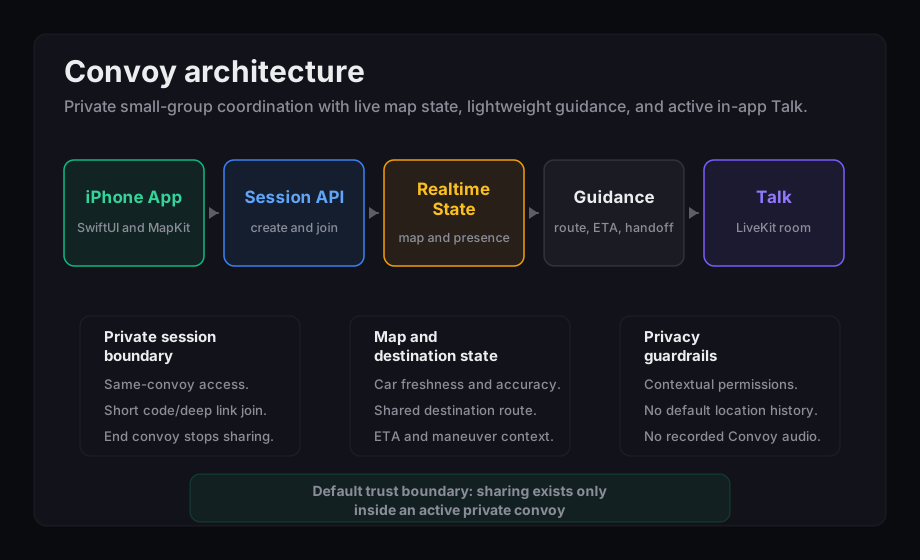
The system combines a SwiftUI iPhone app, MapKit/Core Location, Supabase session and realtime boundaries, LiveKit voice rooms, privacy-first permission timing, and explicit runtime validation gates.
Case Study
Friends driving separately often coordinate through scattered texts, calls, screenshots, and navigation apps. Convoy narrows the problem: a private group deliberately starts a session, shares only the state needed for that drive, and has one obvious way to stop sharing.
Convoy is structured as a thin native iOS client over managed realtime services. SwiftUI owns the app shell and convoy UI, MapKit/Core Location owns map and location behavior, Supabase owns auth, session state, RLS-protected membership, Edge Functions, Broadcast, and Presence, and LiveKit owns active convoy voice rooms.
The public-safe model is category-level: convoy sessions, membership, join codes, same-convoy access boundaries, latest member state, optional shared destination, route/ETA context, realtime Broadcast and Presence, user display names, nicknames, car colors, LiveKit room identity, short-lived token issuance, and end-convoy stop-sharing behavior. Raw endpoint specs, table definitions, policies, and source code stay private.
I shaped the MVP around a deliberately started private convoy, built the deterministic prototype loop, modeled create/join/session state, mapped member identity to car markers, and kept privacy/app review constraints visible while service-backed runtime paths were staged.
Verification includes prototype journey checks, static milestone scripts, Swift/XCTest source coverage, RLS test outlines, copy and privacy reviews, and explicit blockers for Mac/Xcode, Supabase, and LiveKit runtime validation.
Public proof comes from architecture diagrams, state/API category summaries, prototype walkthrough notes, verification summaries, and interview walkthroughs rather than public source code.
Media
This product trailer shows the privacy-first realtime coordination loop: create/join, live map state, destination/route context, Town Hall destination, route intelligence, press-to-talk, and end-convoy cleanup.
Demo with synthetic data.